Posts

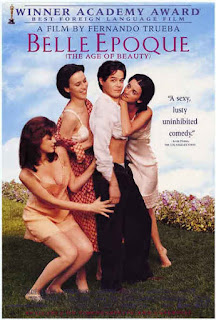
BELLE EPOQUE, FILM. FRIDAY OCTOBER 9TH, 7.30PM.
Image
A French name, but a very Spanish film. Director Fernando Trueba named his movie after the French  Belle Epoque  of the end of the nineteenth century, but this is set in Spain’s own  Age of Beauty , between the First World War and the Spanish Civil War, in 1931. Trueba said about his filmmaking, “I like to hear the audience laughing in a dark theatre.” And that is what this film is designed to do, make people laugh, it is a feel-good film in the best sense of the word. Joyous and uplifting, the film’s themes are pleasure, love and music. It won the Best Foreign Film Oscar in 1993, and it is easy to see why. The setting is rural Spain. Fernando (Jorge Sanz), whose allegiance is to the Republic, deserts from the monarchist army and goes on the run into the Spanish countryside. There he meets Manolo (Fernando Fernán Gómez), a painter who shares his political beliefs. Fernando stays in Manolo’s house for the night and is about to go on his way until he meets Man...

AZULOSCUROCASINEGRO. FILM, FRIDAY, MARCH 6TH.

Image
Jorge trabaja de portero en su edificio, y cuida de su padre enfermo, pero tiene ilusiones más grandes. Cuando su hermano, Antonio, sale de la cárcel, le pide a Jorge algo que le va a cambiar la vida para siempre. Historias triangulares y dilemas de hoy se entremezclan en lo que parece ser el destino     de Jorge, un chico que luchará por lo que quiere, y no por lo que debe. Azuloscurocasinegro es una película divertida, atrevida, conmovedora, que nos muestra la importancia de la amistad, y todas las complicaciones que pueden causar la familia y el amor. Jorge works as a caretaker in his building, and looks after his sick father, but he has greater ambitions. When his brother, Antonio, gets out of prison, he asks Jorge to do something for him that will change Jorge's life forever. Azuloscurocasinegro (Dark blue almost black) is fun, daring and moving. It reveals the importance of friendship, and all of the mes...

FILM, FRIDAY FEBRUARY 6TH. ABRE LOS OJOS.

Image
César (Eduardo Noriega) es un chico guapo y rico al que le gustan mucho las mujeres pero muy poco el compromiso. Sin embargo, en la fiesta de su cumpleaños le enamora de Sofia (Penélope Cruz), la acompañante de su mejor amigo, Pelayo. Al mismo tiempo Nuria, una antigua amante de César, le persigue sin tregua, provocando una serie de acontecimientos que cambiarán la vida de César para siempre.  En esta película fascinante y curiosa, vivimos con César su viaje entre el sueño y la realidad. Rodada en 1997, se hizo un remake en Hollywood en 2001. La película norteamericana se llamaba Vanilla Sky, protagonizada por Tom Cruise, con Penélope Cruz en el mismo papel que hizo en la versión original. (Esta película no es apropriada para niños). César (Eduardo Noriega), is rich and good-looking, and likes girls but not commitment. However, in his birthday party he meets and falls for Sofía (Penélope Cruz), who has come with his best friend, Pelayo (Fele Martíne...

FILM - OCHO APELLIDOS VASCOS - NOVEMBER 27TH.

Image
OCHO APELLIDOS VASCOS The most successful Spanish film of all time at the box office, we in Sligo Spanish Society are pleased to present  Ocho Apellidos Vascos   - Eight Basque Surnames. A comedy in Spanish, with English subtitles, the story revolves around Rafa, from  Seville  in the south of  Spain , who is only interested in meeting women and living the good life. One day, everything changes, when he meets Amaia, a Basque girl from the north, and the first woman to resist his charms. Rafa, determined to conquer her, travels to her village in the Basque country in the north. There, ready to do what it takes to win Amaia, he even passes himself off as a real Basque in order to win the approval of his prospective father-in-law. The comedy and the plot of  Ocho Apellidos Vascos  revolve around the cultural differences between the different regions of  Spain , between Andalucía in the south, with its sun, flamenco, and fierce pri...

INTERMEDIATE COURSE, 2014, CLASS 8

Our eight lesson was about cars. We learnt the different parts of the car in Spanish: Las partes del coche Los faros – the lights El intermitente – the indicators El volante – the steering wheel El embrague – the clutch El freno – the break El acelerador – the accelerator El motor de arranque – the ignition El espejo (retrovisor ) – the mirror El parabrisas – the windscreen El limpia parabrisas – windscreen wiper El freno de mano – handbrake La palanca de cambios – Gear stick We learnt two different phrases to express instructions or commands (you have to…) in Spanish. We have two options: 1)With our impersonal pronoun “se” :    Se + a verb in the 3 rd person of singular Example: Se trabaja para ganar dinero – You have to work to earn money. 2)With “Hay que…”:     Hay que + verb in the infinitve form Example: Hay que trabajar para ganar dinero – You have to work to earn money. We worked on activity nu...

NEW YEAR, NEW COURSES

Image
Starting the week of January 20th, 2014, Sligo Spanish Society are running courses in Spanish at all levels. Courses are nine or ten weeks long, and run until late March. All classes are once a week, and last from 8pm to 9.15, except the Morning Beginners course, which runs from 10.30am to 11.45. New this year is our Leaving Cert Spanish oral exam preparation course (see below). Information and registration night is on Tuesday, January 14th, in Sligo City Hotel, from 7.30 to 9pm. For new students it is important to come to the information night in order to insure a place on a course. Information can also be got by emailing sligospanishsociety@gmail.com or by phone to 086-3749578. Courses available are as follows... BEGINNERS: This course runs every Monda y night, beginning January 20th . The course is for people who have no previous knowledge of Spanish, and will run for nine weeks. Total cost is €120, or €100 for students or the unemployed. MORNING BEGINNERS ...

AUTUMN BEGINNERS COURSE, 2013, CLASS 1

In the first session of our beginner’s course, we introduced ourselves and we talked briefly about the different stereotypes and characteristics we find in the Spanish culture, such as the food, flamenco, the beautiful beaches, bullfighting or siestas (naps). We also talked about the Spanish pronunciation and we saw some examples of words with those particular pronunciations. “ñ” in España (Spain) , uña (nail) , niño (child) “ll” in lluvia (rain), llave (key) , llamar (call, ring) “j, g” in mujer  (woman), gente (people) genio (genious) “q” in queso (cheese) que (what) “r, rr” in perro  (dog) borracho (drunk), ratón ( mouse) “h” in hola (hello) hielo (ice), hermano (brother) “v” in volver  (go back, come back), volar (fly), ver (see) “c, z” in cien (one hundred), zapato (shoe), diez (ten) (It was also worth mentioning that we only have five sounds to the five vowels a,e,I,o,u,  unlike the vowels in the English language which there are twel...